
Unearthed
The stories behind the produce
Know Your Farmers with flinders Truffles
Author: Interview & Editorial by Michelle Siwka. Images by Amber Gardener.
Join us for a kitchen table Q & A with Jane and Tony from Flinders Truffles
Interview with Jane & Tony Groves
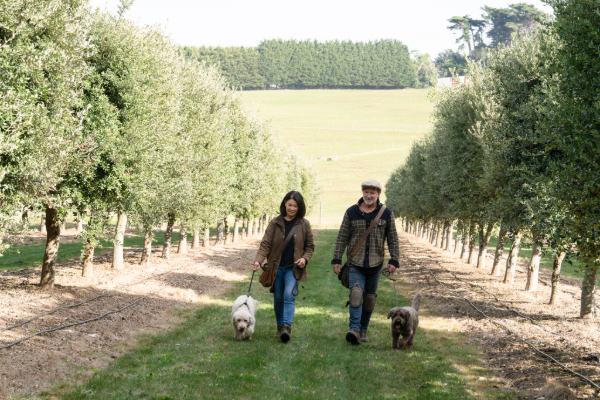
Set among the windswept coastal hills of the Mornington Peninsula, Flinders Truffles is a farm shaped by what you can’t see, as well as what you can. Beneath rows of carefully tended trees, the real work happens underground – a crop that can’t be rushed, one that requires patience, persistence and a willingness to work with the unknown.
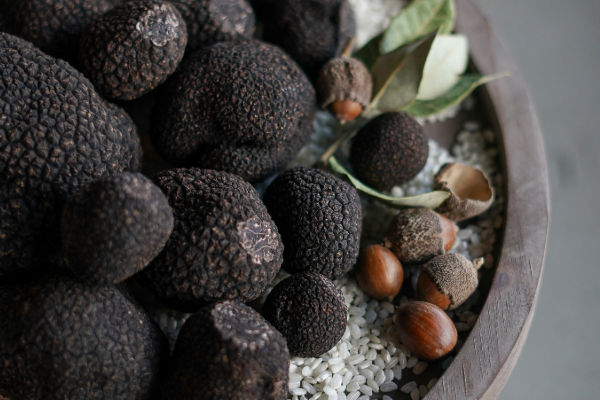
For Jane and Tony, growing Perigord truffles here is very much about terroir – working closely with the seasons, the soil and the conditions of the land, understanding how each year unfolds. The truffles themselves are dark and intensely aromatic, shaped not only by where they’re grown, but by the careful handling and undivided attention they’re given at every stage.
Q1 How did Flinders Truffles begin, and what first drew you to growing truffles?
For us, it really started with a love of the land & a passion for gardening, which I get from my mum, and a long-standing love of growing things…and for me, especially things that are unusual or challenging.
The idea itself came about quite simply. After visiting an open garden, I was raving about the scale of the mature trees, to a friend who’s a real foodie, and she said, you should grow truffles. And that was it. From there, we ran with it and have been very busy since.
The more we learned the more fascinated we became. Finding answers to the long list of questions. Why are they such a prized ingredient? Why are they difficult to grow? We delved deep into the research, but some things we only really learnt on the job.
We knew it wouldn’t be easy, but we took on the challenge.
We started our search for the suitable property. We went looking for land with the intention of growing truffles, so everything here was chosen with that in mind – the site, the slope, the conditions, and the property’s past farming practices.
Part of the intrigue was that it felt unlikely. Truffles are something you associate with Europe, and even now there’s still a sense of surprise that they can be grown here in Victoria.
There’s something about the first time you have truffles; it’s one of those moments that stays with you. It feels special, unique, exotic even.
I remember watching documentaries and just thinking how fascinating it was that dogs were finding them, uncovering something from the ground that you can’t see. That connection between the soil, the trees and the seasons, and then the role of the dogs in finding them, it all just pulled us in.
Having a farm ticked a few boxes for us. It provides the land to nurture our family, the space to feel free, a place to use existing skills and develop new ones, and somewhere to be creative and physical all at once.
Q2 What is it about the climate and soil here in Flinders that makes it suitable for growing truffles?
It’s really the combination of climate, soil and rainfall that makes Flinders so well suited to growing truffles. The way the land sits, including aspects of drainage, also plays a role in creating the right environment for truffles to thrive. What we’re really doing is recreating a managed way, for something that naturally occurs in the wild.
Truffles have traditionally been foraged rather than farmed, particularly throughout Europe where knowledge of wild truffle locations is closely guarded. Modern truffle farming is about understanding those natural systems and carefully replicating the conditions they need to produce consistently.
When searching for land, it was important to find a site that hadn’t been heavily worked or over farmed. The soil here was naturally rich, full of organic matter and hadn’t been heavily sprayed or altered, giving us a strong foundation from the beginning. We’re on a clay loam soil, which holds nutrients and moisture, although early work focused on reducing compaction from years of grazing before planting began.
The climate here is also well suited, with warm summers followed by cold winters. Conditions are similar to parts of the Mediterranean, particularly Spain, where we spent time learning from established growers. Truffles prefer alkaline soils, so we adjusted the pH with lime to create the ideal balance for growth.
Across the farm we follow regenerative practices, including covercropping, grazing cattle and building long term soil health and biodiversity. We don’t use pesticides, and while we’re not certified organic, our approach is very much aligned with working alongside nature to create a healthy and sustainable system.
Q3 Is there a moment in the season that feels especially rewarding or satisfying?
One of the most rewarding parts of the season is reaching that point in mid to late winter when everything starts to come together. Early in the season in June, we’re constantly checking truffles for maturity. The dogs locate one, we’ll carefully uncover a small area, assess the colour, aroma and firmness, and if all things are not perfect, we cover it back with soil and return later, once it’s had more time in the cold soil to fully develop.
By mid-July, the truffles have usually had that extra time to mature and the whole process becomes more instinctive and enjoyable. The dogs detect, we unearth confidently, and suddenly your basket is full of beautifully ripe truffles, day after day in the crisp winter air.
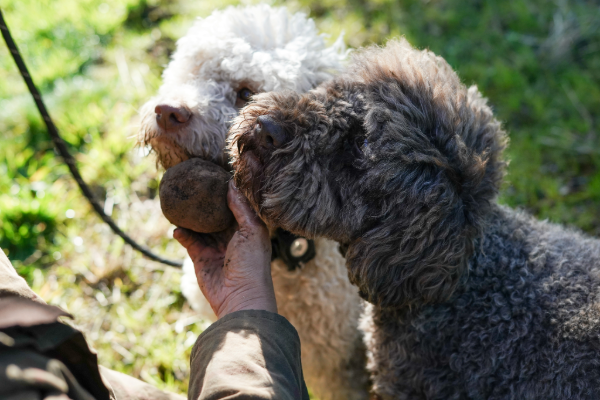
Working with our dogs is a huge part of what makes this so special. They absolutely love truffle season and know exactly what’s happening the moment they see the lead, knee pads and hunting bags come out. Once you fall into a rhythm together, quietly moving through the orchard, using simple commands, listening to paws on the soil, keen sniffing and watching them work, there’s a real sense of connection and teamwork that’s hard to describe.
There’s also something remarkable about lifting a mature truffle from the ground and catching that aroma before you see it. No matter how many seasons you do, that moment never really loses its magic.
Sharing the experience with other people is another highlight. Guests often arrive curious, but before long they’re on their hands and knees in the dirt, completely immersed in the hunt alongside the dogs. Watching people connect with the land, the process and the food in such a genuine way is also very fulfilling.
So, I guess there’s many rewards in what we do here.
Q4 And on the flip side, what are the biggest challenges of growing truffles?
Farming comes with constant challenges, and no two seasons are ever the same. Weather is one of the biggest factors, as truffles rely on very specific conditions throughout the year. In the early days, the main focus was establishing healthy trees and building the right environment.
Early on, insects and pests caused some of the biggest issues, particularly damage to the truffles underground. Over time, we’ve learned a lot about managing that naturally through pruning, airflow and reducing organic matter on the orchard floor.
One of the unique challenges is that you can’t see what you’re growing. As the season approaches, small cracks or eruptions in the soil can hint at where truffles are forming, but there’s always uncertainty. Conditions need to be balanced; too close to the surface and they become vulnerable to pests and damage, too much moisture and they can rot, not enough moisture and they don’t develop. So, I guess a lot of truffle farming is patience, practice and anticipation.
There’s also the challenge of building demand for what is still a relatively young industry in Australia. Most Australian truffles are exported, around 80% from a total production of around 18 to 20 tonnes a year, and that’s expected to grow to 30 or 40 tonnes over the next five or six years. But there is growing appreciation locally for fresh, seasonal truffles used properly rather than artificial truffle products.
Due to the harvest window being so short, timing is critical, and competition globally continues to grow, with Southern Hemisphere countries producing at the same time.
And that seasonality is also what makes truffles so special. We’re incredibly fortunate on the Mornington Peninsula to work alongside talented chefs and producers who value local, seasonal food and showcase it in such creative ways.
Seeing how each chef uses truffles differently, and following the journey from soil to plate, are some of the most rewarding parts of what we do.
We’ve got a few creative ideas of our own this year as well…so watch this space.
Q5 What’s something people often misunderstand about truffles or how they’re grown?
There are quite a few misconceptions. One of the biggest is that all truffles are the same, that a truffle grown here will be the same as one grown somewhere else and that’s just not true. Like wine, they’re very much influenced by where they’re grown. Different soils, even different parts of the same farm, can produce truffles with their own characteristics and that’s something people don’t always realise.
Even the soil itself can influence the shape. In heavier clay soils, the truffle has less room to expand, so you tend to get more irregular forms, whereas in a sandy loam it can push out more easily and develop a smoother shape.
There’s also a perception around quality based on appearance. People may think a perfectly round, smooth truffle is better in quality, but that’s not necessarily the case. Some of the more unusual, irregular shapes, the ones that look a bit wild, can be exactly the same if not superior in quality.
The biggest misconception, though, is that you can simply plant inoculated trees and expect truffles to grow. It doesn’t work like that. You still have to get everything else right – the soil, the pruning, the pH, the overall management and even then, you’re working with something you can’t see.
A lot of it comes down to the conditions. If there’s a lack of water, we can control the moisture we put on, but we can’t turn the rain off if it keeps coming. Soil preparation is really important. If you don’t get that right in the first year or two, you’ll struggle later on. There are farms, even large ones, that haven’t produced a truffle in 20 years.
We grow winter Perigord truffles here, and the relationship between the tree and the truffle is everything. It’s a true partnership. The truffle relies on the tree for sugars, and in return it helps the tree draw nutrients from the soil – it’s a two-way exchange happening underground.
One of the biggest adjustments we had to make was realising we weren’t just caring for the trees but actually pruning and watering for the truffle production. And even then, you can’t always judge what’s happening below the surface. Some of the smallest, least impressive- looking trees can produce beautiful truffles, so you learn not to rely on what you see above ground.
We’re starting to use things like geo-mapping as well, which gives us a better understanding of what’s happening beneath the surface, where truffles are forming and how different parts of the orchard are behaving.
It’s also far more physical than people expect. There’s a lot of time on your hands and knees, a lot of repetition – it’s demanding outdoor work in the coldest time of the year, especially if you’re doing it all yourselves. But that’s also part of what makes it so satisfying.
Q6 You speak about a deep respect for nature and seasonality. What does that mean to you?
Seasonality is about respecting nature’s natural rhythm, enjoying produce at its peak, exactly when it’s meant to be harvested, this is what gives food its depth, character and authenticity.
For truffles, seasonality matters because their aroma and flavour are fleeting and impossible to replicate outside their natural harvest window. Waiting paitiently for the right moment ensures a richer, more complex product while supporting sustainable farming practices and a stronger connection to the land.
So, seasonality really is at the core of everything we do. While winter black truffle harvest runs from June – August, the work itself is a year-round cycle. The truffles develop through spring and summer before slowly maturing in the cold of winter, every season playing an important role on the farm. There’s never really an off season, only different stages of the cycle.
Timing is critical throughout the year. Pruning, planting, soil work and reinoculating all happen within very specific windows, which is quite a job with 1200 trees to manage.
Even during harvest, timing matters – pick too early and the truffle isn’t ready, pick too late and it’s past its best. As soon as one season ends, preparation for the next begins.
Respect for the soil and the wider farm is a big part of that cycle. Using cover crops, grazing cattle and sheep, and returning organic matter back into the soil all help create a healthier, more self-sustaining system over time. Rather than forcing nature, we work with the seasons and respond to what the land needs. For us, following that full cycle from growth to harvest is what makes truffle farming so rewarding, and we believe what contributes to our truffles’ depth, quality and character.
Q7 Truffles have such a distinctive flavour, often described as rich and umami. How would you describe the flavour of your truffles, and what do you think sets their quality apart?
They’re often described as rich and umami, but they’re far more complex than that. Even within the same harvest, in the same basket, every truffle can have its own aroma profile and that’s part of what makes them so fascinating.
You might get notes of red wine, something a bit chocolatey, sometimes nutty but there’s always that underlying earthiness. When you smell a truffle straight out of the ground, with the soil still on it, that’s when it’s at its most expressive – that real forest floor character.
It’s not just about flavour either. It’s a full sensory experience – the aroma, the taste, even the way it’s served. That’s why it’s often shaved over food, you get that lift of aroma as well as the flavour, along with that visual moment.
In terms of what sets ours apart, our Flinders truffles are known for being distinctly dark on the inside (also known as the Gleba) with fine white veins. Even among black truffles, some can lean towards brown depending on where they’re grown, but ours are consistently very black, they really are true black truffles.
They’re actually getting darker as the farm matures, which is really interesting. It’s something people in the industry can pick, wholesalers who see a lot of truffles from different growers can often identify them.
We also put a lot of focus on the soil, with tillage under the trees to keep it open and friable. It creates less resistance in the soil at that early stage, when the spores are separating and the truffle is beginning to form. That allows it to expand more evenly as it develops, and we get a nice, uniform shape.
Timing also plays a big role here. A truffle might be amazing straight out of the ground, but after a couple of days stored correctly, can really reach its peak, that’s when the aroma and flavour can often be at its best.
Q8 Tell us about Lucy and Enzo. What role do they play in the harvest?
They’re absolutely central to everything we do, they’re the hunters. Because truffles grow underground, we rely entirely on the dogs to locate them.
Truffles naturally evolved to be found by animals, eating the truffle and spreading the spores throughout the forest floor, so that intense, unique aroma is an important part of their life cycle. The dogs are trained to recognise and respond to that scent.
I trained Lucy and Enzo, after working with Steve Austin, a professional trainer, to learn the foundations of scent work and handling. From there, it’s been about consistency, repetition and reward-based training, always using the same cues and language.
It’s surprisingly demanding work for them mentally, so we are mindful to give them breaks between hunts, although they would happily keep going all day if we let them.
They genuinely love truffle season, and they also feel the excitement build in the lead up to winter. Outside the orchard, they’re also our loved family dogs. They come home muddy, as we also do, sleep on the couch, and in the off season they’re swimming in the bay and the dam.
Leading into the next season, training starts up again, sharpening their senses and increasing their fitness and stamina, in preparation for an intensive 3 months of work.
Q9 Where do your truffles tend to go once they’re harvested, are there local chefs or kitchens you love seeing them used in?
A lot of our truffles go to local restaurants, and we’re really lucky here on the Peninsula, there are so many talented chefs who really celebrate quality local and seasonal produce.
It’s hard to single out just a few, but we do work quite closely with a number of them. Places like Point Leo Estate, Ten Minutes by Tractor, Tedesca, Polperro, have all done beautiful things with our truffles, and we’ve collaborated on a few experiences as well.
There might be truffle hunts paired with lunches or dinners, or chefs coming here to cook on the farm. We’ve had chefs host lunches out here, which is really special, it brings people right into the environment where the truffles are grown.
I have to admit, I also love delivery days, because you get to see behind the scenes; kitchens in full prep mode…everything happening at once. It’s organised chaos, but it’s also where the magic happens. And then there are places like Alba Thermal Springs, where we’ve made time for a quick spa after delivering to the restaurant. A small bonus.
We also invite chefs and their teams to the farm, which we’ve been doing more of over the last couple of years. It gives them the full experience, they can see the dogs at work, harvest a truffle themselves and really understand where the product comes from. Not all chefs have had that opportunity, so it’s something they really value, and it gives both the kitchen and front of house teams a story they can take back to their customers.
We also do some work in Melbourne, mostly through events and truffle dinners. Places like Estelle in Northcote, Chancery Lane, Smith St Bistrot have been great to work with – those dinners are a full truffle experience, with it featured across the whole menu. We’ll often be there as well, talking to people about what we do and where it comes from.
I like seeing guests faces when they hold a whole truffle. Most people have only had it presented on a dish, so being able to hold one and smell it really changes the experience.
Q10 How do you like to enjoy truffles at home, and what’s a simple way people can use them?
We keep it really simple at home. That’s probably the biggest thing – don’t overthink it and don’t be afraid of using it.
Truffle works best with simple, warm dishes. One of our go-to’s is just a really good pasta with butter. We’ll gently warm some unsalted butter, let it cool slightly, then shave truffle into it and toss it through the pasta, finishing with a bit more shaved over the top. That’s our benchmark, it really lets the truffle shine.
It pairs so well with fats like butter, cream, cheese but you can only have so much of that. So for me, it’s often something simpler like eggs – scrambled or on a fluffy omelette, or a light risotto where it doesn’t feel too heavy. It’s also beautiful through something like a mashed potato with truffle butter, or even folded through a simple blanc de blanc-style sauce. At home, the kids love it in a truffle mac and cheese, so it definitely doesn’t have to be complicated.
The main thing is not to cook it at high heat. Once it gets too hot, you lose that aroma. It’s better for us to add it at the end and let the warmth of the dish release the aromatics. And if people are unsure, we do have recipes on our website to help get them started, from really simple ideas through to something a bit more involved.
If you’ve got some left at the end of the week, a really easy way to extend it is to fold it through butter. You can roll it into a log, keep it in the fridge or even freeze it, and then slice off what you need. It’s perfect for finishing something simple, like good local produce, potatoes from Hawkes Farm, on top of a steak from Torello, or like our kids, straight onto sourdough toast.
Q11 When friends visit from out of town, where do you love to take them on the Peninsula?
It really depends who they are, how rowdy and how many there are, but we’re pretty spoilt for choice on the Peninsula. If we’re going out, we’ll book somewhere we love. Tedesca is always incredible, the food, the philosophy, and the whole experience are just beautiful. Many Little, Crittendens Winery & Pt Leo Estate are also high on the list.
More family friendly, our go to’s are Fontalina Balnarring, Tulum Store – a hidden gem also in Balnarring serving up some big flavours, or Pho@Flinders and Plonk and Stink Flinders, for a quick bite or a knock-off drink. If we have time for breakfast or brunch we go to MilkBar & Co, and South Beach Project in Mt Martha.
But just as often, it’s not about booking somewhere at all. We love heading to the markets or picking up produce locally; fresh bread, cheeses, local wines, putting together a bit of everything, then heading somewhere nice for a picnic, or even back to our farm, to enjoy it without working on it. A basket full of local produce is something we’ve always loved doing when we travel and is so easy and available here on the Peninsula, it’s such an abundant food bowl.
There’s a real sense of connection across the Peninsula. We recommend different places to friends and farm guests to visit, and we also have people referred to us from Cape Schanck RACV, Jackalope and others who we also partner with – it’s very much a shared network, with everyone supporting each other. Accommodation as well, many local Airbnb’s and places to stay will send their guests here, and then we’ll point them back out to different spots across the region. It all feeds into each other.
And then, of course, we’ll bring our guests here.
We’re open to the public on weekends during winter, so visitors can come and experience it for themselves. The farm gate is open from 10–3pm, with a food van serving favourites like our signature cheese & truffle toasties, or hot soup, which of course is finished with fresh shaved truffle.
People are free to sit by the open fire & stay as long as they like. We also run pre-booked truffle hunts, where you can fully immersive yourself in the whole experience. Watch our dogs detect truffles underground, learn how to carefully unearth each truffle, with an opportunity to try harvesting one, or learn how to clean, grade, store and prepare fresh truffles at home.
It’s a really nice way to spend a Winter’s afternoon, and it’s great seeing more people coming down to the Peninsula during that quieter time of year.
We’re also starting to open things up a bit more beyond that, creating a space here where people can come for small events or corporate-style gatherings – bring a team to the farm, take a private hunt and then share a catered meal together. It’s a unique experience, fun and a little physical to keep you warm, especially in winter, and something we’re really excited to keep building.
Getting to know the people behind the produce.
Unearth the Producers in this Article