Food lovers Guide to Winter
Winter on the Mornington Peninsula is a time to slip on the boots, pull on a woolly jumper and explore our farm gates and cellar doors to hunt for fungus and stock up for slow braises and winter stews. It’s also the season when the new year’s olive oil is bottled and released.
On the rolling hills above Cape Schanck, overlooking the pounding swell of Bass Strait, sits Cape Schanck Olive Estate. Over 2,000 olive trees — frantoio, leccino, picual and picholine varieties — grow in neatly spaced rows across the undulating land.
Here, they are harvested in a unique way. Each variety is picked, pressed and bottled separately, allowing each to express its own flavours. “We wanted to make a premium product that speaks of where it’s grown,” says Sui Tham, who runs the grove with her husband Stephen. “So we make oils that have their own sense of terroir.”
The olives are harvested at the end of autumn and cold-pressed within minutes, ensuring the oils retain their vibrant character — from grassy and herbal to nutty and softly aniseed. Some is bottled immediately as First Harvest; the rest is stored carefully for bottling on demand. These elegant extra virgin olive oils have earned their place in the kitchens of top restaurants across the Peninsula and are sold in our best grocers and provedores.
Further up the coast, not far from the historic Coolart homestead, Somers farmer John Pederson and his wife Catriona McLean are preparing for lambing season. They have a flock of around 90 Wiltshire Horn ewes and a couple of rams, raised on their 40-hectare property. Wiltshire Horn is an ancient meat breed, prized since Roman times, producing flesh of extraordinary depth — rich in flavour, fine in texture, and lusciously marbled with just the right amount of fat.
It is considered by many to be the finest meat-breed lamb in Australia. What makes the Luxton Park flock even more distinctive is its black colour. John has bred his own line of dark-fleeced sheep, which he calls Australian Blackshires. “They’re calm, hardy, and perfectly suited to small properties,” he says. This winter, many of their breeding ewes will give birth to twins, ensuring a steady supply of some of the region’s finest, most ethical lamb and hogget — perfect for winter braises. Contact John directly for flock and meat sale enquiries.
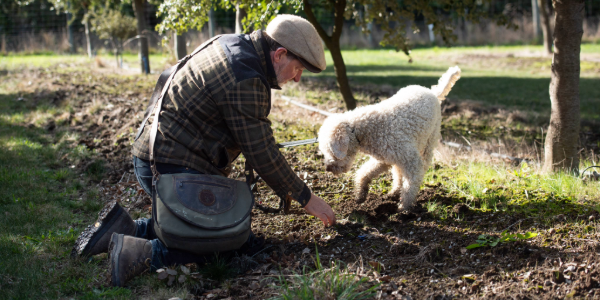
And while the sheep graze and the olives settle into tanks, another crop is growing beneath the soil in the hills above Flinders. At Flinders Truffles, 1,200 holm oaks are host to a much sought-after winter delicacy: black truffles. Here, Tony and Jane Groves have spent more than a decade cultivating these subterranean fungi on their sheep and cattle farm. With the help of Enzo and Lucy, their expert truffle dogs, they harvest the aromatic black gold from June through August. Guests can join a weekend hunt, following the eager hounds through the trees before warming up with truffle soup and a cheese toastie by the fire.
“We love truffles,” says Jane. “Truffle season is as fun as it is exciting.” The Groves supply top local kitchens and export globally, but the farmgate is also open to the public, with fresh truffles and handmade products like truffle butter, salt and honey available each weekend.
This is winter on the Mornington Peninsula — from fresh oil to the dark perfume of truffles and the clean finish of heritage-breed lamb. When the temperature drops, it’s time to make the most of the specialities of the colder months.