Unearthed
The stories behind the produce
Know Your Farmers with Tuerong farm
Author: Interview & Editorial by Michelle Siwka. Images by Richard Cornish.
Join us for a kitchen table Q & A with Jason from Tuerong Farm
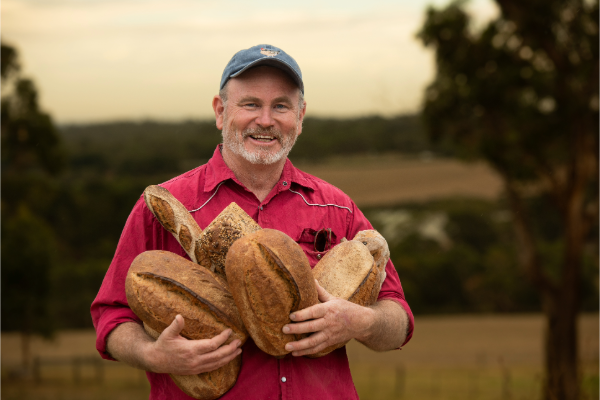
Tuerong Farm is a specialised grain farm, mill and bakery at the heart of the Mornington Peninsula. Jason Cotter, Emma Hicks and their team grow grain, mill flour and bake bread, all on site. Visitors can stop by the farm door to purchase flour, bread and beer, and experience the full journey from paddock to plate in one place.
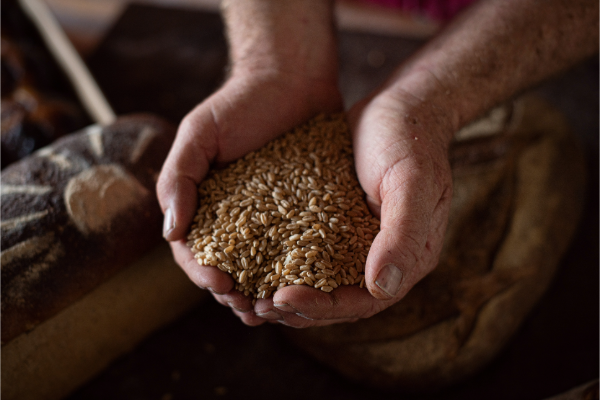
What began as a curiosity about the origins of food has grown into a thriving business and ongoing exploration of grain diversity. Different varieties of wheat, rye and barley are trialled each season, often starting from just five grams of seed. Selected varieties are carefully nurtured over several seasons and assessed for flavour, nutrition and functional quality. This approach results in distinct bread and flour that expresses the traits of specific varieties of heritage, ancient and modern grain, and how they’ve faired over a particular season.
Qn 1: How did Tuerong Farm begin, and what set you on the path of growing grain on the Peninsula?
My family established a vineyard here in the 90s. We made Barrymore wine and bred cattle, but when Emma and I moved here over a decade ago I became curious about the broader food system – where it comes from and how it is grown – particularly after some gut health issues. That led to us growing a few hectares of wheat to see how it would perform in our own particular landscape and to make our own bread.
It did remarkably well. Wheat is diverse, adaptable and largely grown in regions with higher rainfall than Australia’s ‘wheat belt’. But being a long way from traditional wheat growing regions meant we had little access to harvesting and processing equipment. Starting with a small harvester, we’ve gradually developed our own infrastructure and capabilities, and the business has evolved to suit our peri-urban environment. We’ve also followed global food trends that delve into the specifics – the what, where, who and how – to cater to a direct-to-consumer market. This also unearthed a deeper interest in diversity – of genetics, ownership and supply chains – and a focus on flavour, digestion and other quality traits rarely explored in commodity systems.
Qn 2: How do you decide which grain varieties to grow each season, given the diversity you work with?
We grow a wide range of different grains in small trial plots to assess their suitability to what we do and our customer’s end-use, including material from the Australia Grains Gene Bank, the third largest cereals collection in the world, and international collections imported through quarantine. Some varieties yield well but don’t necessarily produce the kind of flour and bread we seek or offer anything distinct from what is more broadly available. Selection is balance of agronomic and quality factors, and whether a variety has a particular story we’d like to tell. If something ticks a few boxes, we pursue it in a wider growing program.
Though we’ve found a number of varieties that suit our land and customers, we continue to explore different grains – it’s something we enjoy. It’s a pleasure to stand in a field of various wheats with a range of presentations, cultural histories and potential, and marvel at how one class of plant is intrinsically linked to our civilisation. The beauty of all that diversity is nourishing too.
Qn 3: Is there a particular grain or variety you wish more people would try?
The huge range of varieties beyond standard bread wheat is what gets me going. In commodity ag and food systems we tend to rely on a fairly narrow range of genetics, whereas globally there’s a broad spectrum of flavour, fibre, nutrition and digestion characteristics. Different grains may have nutty, roasted, creamy, sweet or savoury flavours, and can be satisfying in way the whole body enjoys.
There’s a swag of lovely types that are good eating but don’t suit the efficiencies required of commodity agriculture – outside enterprises like ours, they’re generally not available in Australia. The ones I’m most excited about at present are perennial wheat, blue and purple wheat and a couple of offshoots from the wheat family tree that satisfy the seed hunter in me. Including Triticum Urartu, AKA Wild Red Einkorn, and a line of Triticum vavilovii Emma has dubbed ‘Levin’, after the farmer in Anna Karenina. It a old, tall, large seeded variety that has its own story we can’t wait to tell – look up namesake Nikolai Vavilov sometime.
Qn 4: How does it feel to see chefs and bakers working with the grain you’ve grown here?
Fantastic. We’re amazed and touched that chefs, bakers and the public have connected with what we do. The direct connection between our farm and the end-user is a big part for us. In most grain systems the supply chain is long, with many points between where grain is grown and where it’s ultimately used. Grain is stripped of its identity and genuine traceability, and all authentic connection to source eliminated. Similarly, a farmer’s connection with the eventual eater of what they grow is no longer a given. For many grain growers, wheat is only faintly thought of as food, despite being a key ingredient across the globe.
By working closely with bakers and chefs, we’re able to get instant feedback that genuinely influences what we choose to grow and how we grow it. That ongoing process, along with the origin and specificity of the grain, is important to us. Direct decision-making in the food system is only something a smaller, more local model can foster, and is perhaps best experienced when people come to the farm, try the flour and bread, and have a chat.
Qn 5: Is there a moment in the milling or baking process that you look forward to?
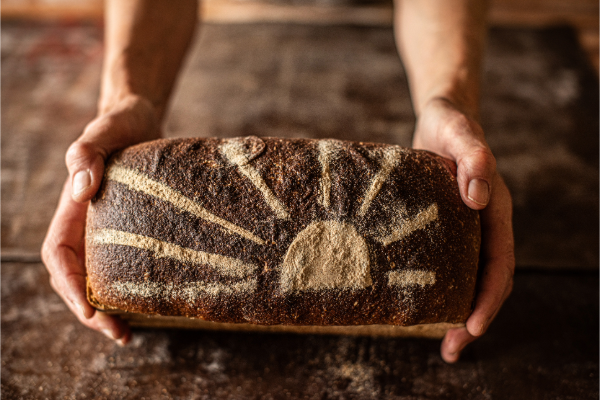
It’s always satisfying to pull a beautiful loaf fresh from the oven in the early hours. Feel the warmth of it in your hands, tear off a chunk and eat it without anything else at the bakery bench. Carbs don’t always have to be the servant of dairy.
I also enjoy the few months after harvest when the grain has been cleaned and settled in, and the bakers start using the new flour and giving feedback. It’s great to get a true sense of how the season has gone and how well particular varieties express, and hear their joy in using this or that.
My true love is before that though, standing among all the different varieties in the trial fields as they come into head in Spring, or stripping a 30-tonne silo worth of grain that at first sowing was only a five-gram thimbleful of seed, collected overseas many years prior.
Qn 6: What does working on the land look like for you day-to-day?
Depends on the time of year. Preparing ground for sowing, keeping the emerged crop healthy, harvesting after it has senesced, cleaning the grain and putting it through the mill. Our tasks shift between the paddock, the mill and bakery, as well as packing orders, welcoming customers and general farm and business work. You might start the day planning to focus on one job but end up doing something else. Farm work can be – for me, anyway – a lot like that scene in The Castle – you’ve got to shift the Camira to get to the Cortina to go pick up the Commodore. There are also regular disruptions – you might start out setting up a seed thresher but end up fixing a trough or learning about solenoids. I love it.
Qn 7: Do you have a bread ritual at home?
I keep it simple. A warm chunk eaten on its own or dipped in garlic confit makes a quick breakfast. The kids often run up for a fresh loaf for their school lunches, but usually we’ve an assortment of half loaves on the bench – a triticale tin loaf, a country, some one-off mixed morsel from leftover dough, or whatever remains on the shelf at the end of the day. Good quality ham and butter for a thick sandwich or a thinner bit toasted and smudged with a cut garlic clove, topped with chopped tomato, olive oil and salt. A sliver of Comte for a Sunday special – a renowned local baker told me about that one. The bread already carries a lot of character, so it doesn’t need anything too elaborate.
Qn 8: Your flour gets used for bread but also for pasta, pastry and home baking. What do you love seeing people make with it?
I really enjoy seeing the things people show me, particularly when they’ve made it from scratch in their own kitchens. I love to see people enjoy baking and their proud pics of their own fresh bread, often as an expression of their culture or love and care for their family. It’s genuinely encouraging for us, to be involved in such a nourishing part of life.
Qn 9: When you get a moment to slow down, what’s your favourite way to spend time on the Peninsula?
We love a swim or snorkel any time of year, but in Summer a cooling dip with the kids after work at Dromana or Merricks hits the spot. In Autumn we forage for mushrooms – we like slender parasols, porcini and longshanks the best, we leave the milkcaps – or explore the back beach rockpools and hinterland nooks further down the Peninsula. Winter, perhaps a blustery walk above some heavy sea then head on to a warm restaurant. YAWA with the kids, a walk in the reserve, a slow drive down some new roads, any time of year.
Q10: If you were sharing a simple meal with friends, what local foods would you reach for?
The Peninsula has a power of great farms and food, even within walking distance. From around Tuerong we enjoy Little Pier olive oil, Woodlands Farm stone fruits, Torello beef lasagne, Devil Bend beer, Moorooduc Estate and Yabby Lake wines, Daniel’s Run tomatoes. Our own beef and beer. Not much further afield, there’s a bunch of other great eats: fish and mussels from the bays, some kelp adornments from Southern Seagreens, cheese from Boathouse or Main Ridge. If you enjoy food and eating with friends, the Peninsula is a wonderful place to be.